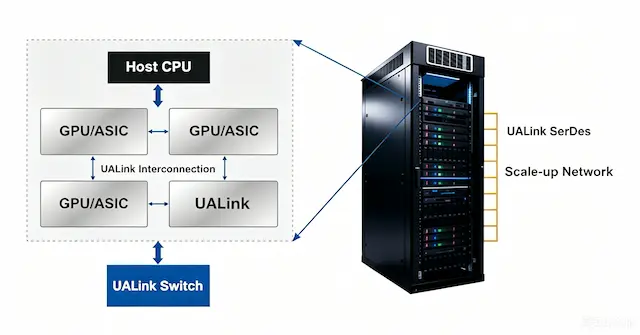
Innosilicon (INNOSILICON™) launches UALink physical layer (PHY) and controller IP cores, built for high-performance chip development in the AI era. The complete solution is fully compliant with the UALink Specification Version 2.0.
The UALink IP integrates high-performance 112G/224G SerDes with fine-grained parameter configuration and excellent environmental adaptability. It delivers stable link transmission under complex conditions such as large-scale networking, traffic fluctuations and temperature and voltage variations, meeting the demanding requirements of long-term stable chip operation.
The UALink IP supports 800Gbps and 400Gbps bandwidth modes and is backward compatible with 200Gbps and 100Gbps, making it the optimal chip-to-chip interconnect for ultra-high-bandwidth, ultra-low-latency super-node devices.
Typical applications: large-scale AI training, high-performance computing (HPC), edge AI inference, switch chips and more.



Leveraging the synergy of "core IP + a complete set of supporting solutions", Innosilicon's one-stop UALink IP supports a wide range of advanced processes. It helps customers avoid the technical risks of developing UALink interconnect IP on their own, shortens the integration cycle of high-speed chip-to-chip interfaces in HPC chips, and helps customers build a core competitive advantage in next-generation low-latency, high-bandwidth interconnect.

Multi-dimensional configurable architecture with three operating modes — direct mode, cluster mode and hybrid direct + cluster mode — compatible with mesh topologies, switch fabrics and other complex scenarios to meet diverse deployment needs;
Deeply optimized for AI: higher data rates, lower power, smaller chip area, and stronger link noise immunity and stability;
A variety of hardened IP delivery options that speed up chip integration and lower customers' R&D costs;
Supporting advanced packaging and PCB co-design services to unlock the IP's full performance and ensure long-term stable operation;
Technical support across the whole flow from front-end design to mass-production debugging, with on-time delivery and worry-free support.
UALink-Specific Features
Integrated 112G/224G high-speed SerDes;
Total bandwidth of 800Gbps/400Gbps, backward compatible with 200Gbps and 100Gbps;
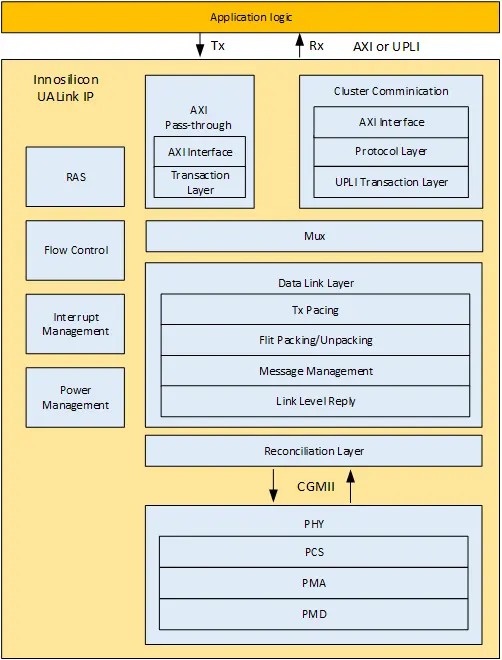
Supports standard AXI3/4/5 bus interfaces or the dedicated UPLI interface;
Two selectable transfer modes: ultra-low-latency mode and high-reliability mode;
Link auto-negotiation and link training, greatly simplifying system integration;
Handles channel loss of up to 35dB;
Supports 4 RS forward error correction (RSFEC) modes: FEC off, RSFEC-68, RSFEC-272, RSFEC-544;
Native support for in-network computing
General UALink Features
Built-in MMU in cluster mode mapping AXI addresses to UPLI ports;
Address compression and decompression to improve effective bandwidth utilization;
Link-level retransmission in the data link layer;
Complete RAS design: TX/RX data drop modes and fault isolation mode; automatic AXI error responses on switch fabric faults to prevent bus hangs;
Unified transfer management for basic messages, control messages and UART messages;
Built-in BIST self-test module and AXI performance monitor;
Integrated link control and transmit-side rate pacing.
Datasheet, integration guide and supporting documentation;
Simulation models and test cases;
LIB timing libraries and LEF layout files;
Standardized software drivers;
Signal integrity / power integrity (SI/PI) analysis reports;
Tape-out sign-off reports;
GDSII layout files.
RTL simulation model
Driver C code