Innosilicon's HDMI IP is designed to transmit or receive video and audio signals between video source devices and display devices and is fully compliant with the HDMI2.1/2.0/1.4 and DVI1.0 specifications. Both PHY and controller solutions are available. Innosilicon's HDMI IP provides a reliable implementation of the HDMI interface for integration into SoCs used in multimedia devices.


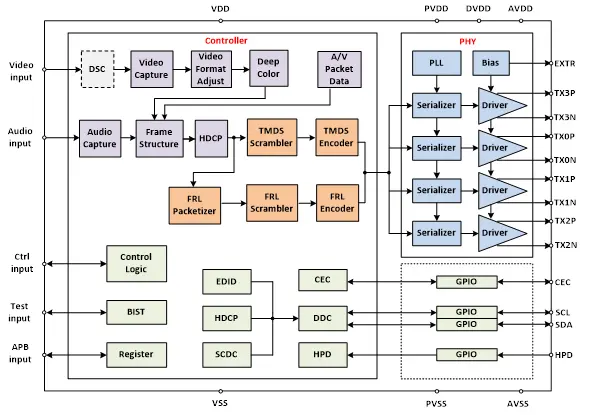
Innosilicon's HDMI TX IP transmits video and audio data from a video source device to a display device. It contains a digital controller and a physical layer. The digital controller processes incoming video and audio data and outputs encoded data to the physical layer. The physical layer contains the clock channel, data channels, PLL and bias circuit, and converts parallel data into a serial stream.
Innosilicon's HDMI RX IP receives and recovers video and audio data from HDMI source devices. It also contains a physical layer and a digital controller. The physical layer converts the received serial stream into digital parallel data for the digital controller, which decodes the parallel data and recovers the video and audio information.


Low power
Fully customizable
Small area
Simple integration process
Available options include
Test chip and test board
FPGA integration support
Chip-level integration
Compliant with HDMI2.1, HDMI2.0, HDMI1.4 and DVI1.0
Data rates up to 12Gbps per data channel and 8K60 resolution
Supports TMDS mode and FRL mode in 3-channel or 4-channel configurations
Supports RGB and YCbCr444/422/420 video formats with 8/10/12-bit color depth
Supports 8-channel I2S and 2-channel S/PDIF audio interfaces with sample rates up to 192KHz
Supports HDCP1.4, HDCP2.2 and HDCP2.3
Supports DSC1.2a
Supports eARC/ARC
Adjustable termination resistance, swing and equalization
Supports SSC modulation
Supports BIST and loopback
APB slave interface for internal register access
Built-in low-jitter PLL and bandgap reference
Area and power depend closely on the process node; see the detailed datasheet
Datasheet and physical implementation guide; netlist (Spice format for LVS)
Timing library model (LIB)
Encrypted Verilog model
Library Exchange Format (LEF)
GDSII database
Evaluation board (if available)